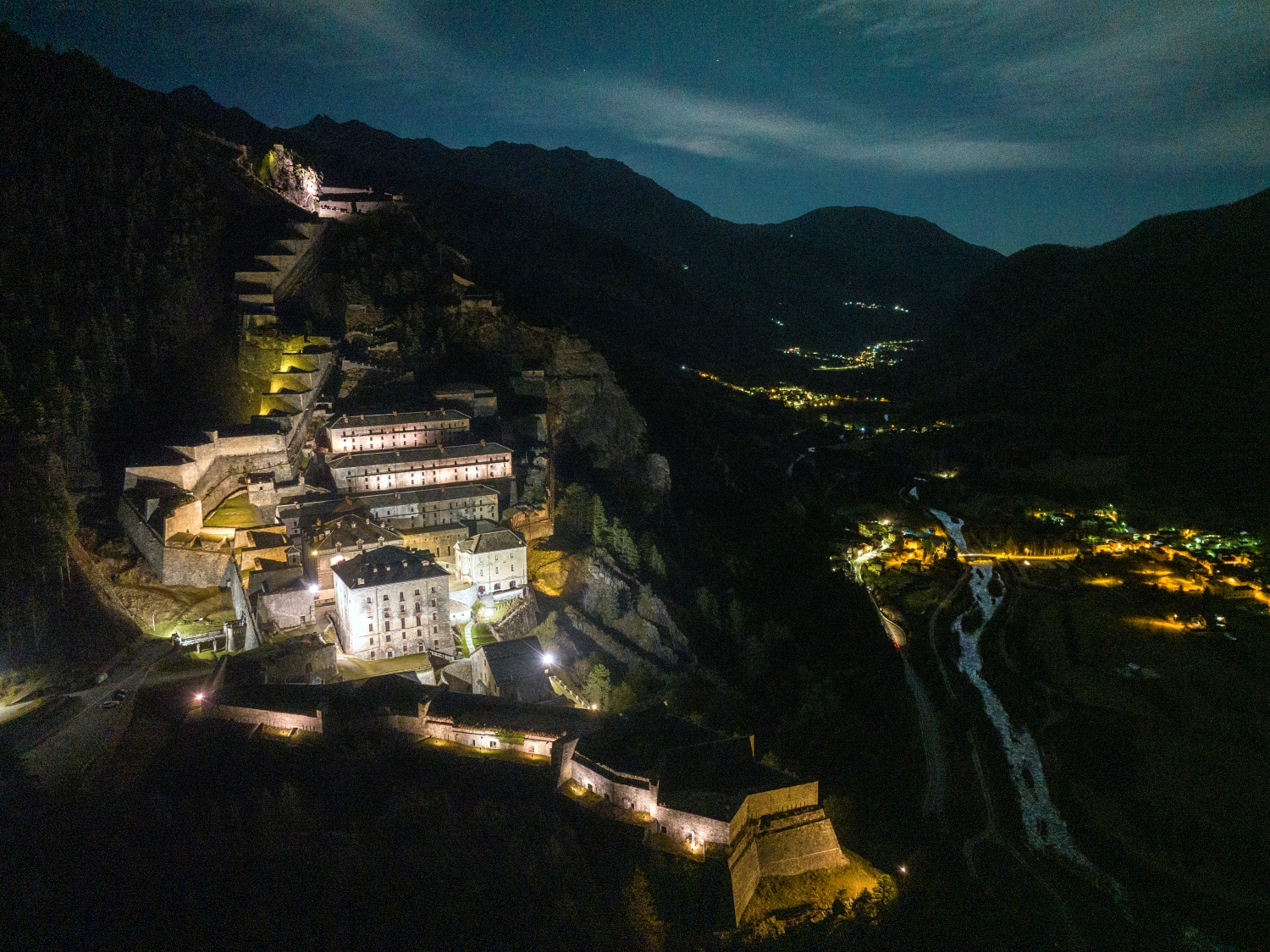
The Fenestrelle Fortress, known as the ‘Great Wall of the Alps’, is a monumental masterpiece of military architecture. As the largest Alpine fortification in Europe, it covers 1.3 million square metres in the Piedmontese Val Chisone. Its construction, under the architect Ignazio Bertola, lasted from 1728 to 1850.
Its special features as a mountain fortress are particularly evident in its topographical adaptation: unlike compact fortresses on flat land, Fenestrelle follows a linear, terraced concept that stretches up the mountainside like a stone barrier over a massive difference in altitude of about 635 to 700 metres. The complex organically integrates natural rock ledges and gorges as defensive elements, so that from a distance it appears to be part of the mountain itself. A specific feature of Alpine fortification architecture is its ability to cope with extreme climatic conditions: the Scala Coperta, a brick tunnel with 3,996 steps, enabled the garrison to move troops between 1,100 m and 1,800 m above sea level all year round, protected from the weather and bombproof.
In addition, 28 terraced risalti (artillery batteries) covered every blind spot on the steep slope. This vertical staggered arrangement of the forts San Carlo, Tre Denti and Delle Valli was so daunting that there was never a major siege. Today, the fortress, which also served as a state prison, is the official symbol of the metropolitan city of Turin.
Location and topography
The Fenestrelle Fortress, often referred to as the ‘Great Wall of Piedmont’, is located in the northern Italian region of Piedmont, about 60 to 80 kilometres west of Turin.
It towers above the village of Fenestrelle in the Val Chisone, a strategically important high alpine valley in the Cottian Alps, which has served as one of the most important transit routes between France and the Po Valley since the Middle Ages. The topographical feature of the complex is its extreme vertical extension: it stretches over a horizontal distance of about three to five kilometres along a steep mountain slope, overcoming a massive difference in altitude of approximately 635 to 700 metres. The fortress begins in the valley at an altitude of about 1,100 metres with the Ridotta Carlo Alberto and culminates in the Forte delle Valli on the ridge of Mount Pinaia at 1,800 metres above sea level. This exposed location enabled the garrison to control the entire valley without interruption. The architects integrated the fortifications organically into the rock, so that from a distance they appear to be part of the mountain itself.
Construction history
The genesis of the fortress is closely linked to the geopolitical tensions between the House of Savoy and France. The modern history of the fortifications began in 1694 with the construction of the French Fort Mutin under Louis XIV, based on plans by Vauban. After the conquest by Victor Amadeus II of Savoy in 1708 and the official cession of the territory in the Treaty of Utrecht (1713), Fort Mutin was deemed inadequate. In 1727, military engineer Ignazio Bertola was commissioned to design a much more powerful structure. The actual construction phase of the present-day complex began in the summer of 1728 and lasted a total of 122 years. During the most intensive phases, over 4,000 workers were involved at the same time. After interruptions during the Napoleonic era, construction was resumed under King Charles Albert in 1836 and finally completed in 1850 with the completion of the Ridotta Carlo Alberto. By the time it was completed, the fortress was already partially obsolete militarily due to the rapid development of artillery technology.
Overall concept and structure
In contrast to traditional, compact star-shaped fortresses, Fenestrelle follows a linear, terraced concept. The complex is designed as a massive barricade, staggered up the mountainside and consisting of three main fortresses that are operationally connected to each other: the Fort San Carlo at the lowest level, the Fort Tre Denti as an intermediate station and the Forte delle Valli at the top. These core elements are linked by a network of seven redoubts (such as Santa Barbara and delle Porte), 28 terraced artillery batteries (risalti) and a continuous wall structure approximately three kilometres long. The total built-up area covers approximately 1.3 to 1.35 million square metres. The centrepiece, Fort San Carlo, served as the administrative centre and houses representative buildings such as the governor’s palace and a church. A unique feature is the connection of all parts by monumental staircase systems, which enable protected communication across the entire height difference.
Function and use
Die primäre Aufgabe der Festung war die Funktion als strategische Defensivbarriere zum Schutz Turins vor französischen Invasionen. Interessanterweise war ihre psychologische Abschreckungswirkung so groß, dass es während ihrer gesamten aktiven Dienstzeit nie zu einer größeren Belagerung kam. Neben der militärischen Nutzung diente Fenestrelle über weite Strecken als berüchtigtes Staatsgefängnis. Zu den prominenten Inhaftierten zählten der Philosoph Joseph de Maistre und Kardinal Bartolomeo Pacca. Besonders bemerkenswert ist die Inhaftierung von Pierre Picaud, dessen Lebensgeschichte Alexandre Dumas als Inspiration für „Der Graf von Monte Christo“ diente. Nach der Vereinigung Italiens 1861 wurden dort tausende Soldaten des untergegangenen Königreichs beider Sizilien sowie politische Dissidenten interniert. Ab 1887 wurde die Festung zum Stützpunkt des 3. Alpini-Regiments, was ihre Bedeutung für die Gebirgskriegsführung unterstrich. Erst 1947 wurde die Anlage offiziell dekommissioniert und dem Verfall preisgegeben.
Architectural features
The most outstanding feature of the fortress is the Scala Coperta (covered staircase), a unique brick tunnel that covers a length of almost two kilometres and comprises 3,996 steps. It is designed to be ‘bombproof’, with outer walls up to two metres thick, and allowed the garrison to reach all sectors regardless of weather conditions and protected from shelling. Parallel to this, the Scala Reale (Royal Staircase) runs outdoors with around 2,500 to 3,000 steps, which was primarily used for ceremonial purposes. Another striking element are the 28 Risalti, gigantic stone artillery positions that rise like steps on the slope and could cover every blind spot on the terrain. Among the architectural highlights of Fort San Carlo are the three-storey Governor’s Palace from 1740, the comfortable officers’ pavilion with 44 heated rooms, and the Baroque church of San Carlo. Technical sophistication is also evident in the Ponte Rosso, a bridge with integrated mine chambers that could be blown up in the event of an attack.
Significance today
Today, the Fenestrelle Fortress is the official symbol of the metropolitan city of Turin and an important cultural monument. After the complex was severely damaged by looting and weathering after the Second World War, a new life cycle began in 1990 thanks to the voluntary work of the Associazione Progetto San Carlo. In 2007, the fortress was included in the World Monuments Fund (WMF) list of the 100 most endangered cultural monuments in the world, underlining its international significance. Every year, the various tours – from short visits to the seven-hour ‘royal hike’ to the summit – attract tens of thousands of visitors. There are also efforts to have it nominated as a UNESCO World Heritage Site under the title ‘European Mountain Fortresses’. Today, Fenestrelle serves as a living museum of military architecture and an important tourist attraction for the Val Chisone.


If you see this after your page is loaded completely, leafletJS files are missing.
Contact
 English
  Polish
Leave a Reply