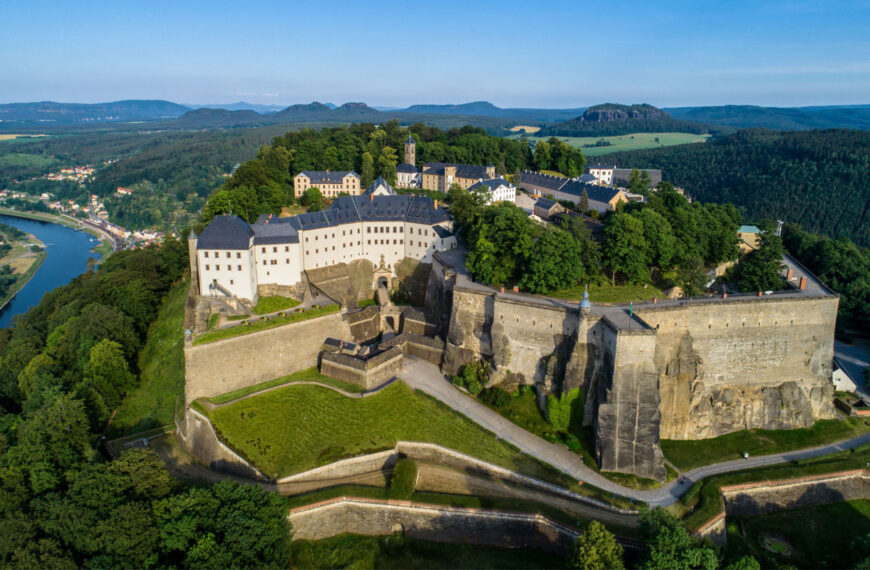
Nestled in the Elbe Sandstone Mountains, the town of Königstein lies on the banks of the River Elbe. The Königstein fortress of the same name, one of the largest and most beautiful mountain fortresses in Europe, is enthroned on the table mountain high above it. The fantastic view alone, which can be enjoyed from almost every point along the 1700 metre-long rampart walk, is worth the climb.
In addition to the panorama, the exciting architecture and history, the extremely varied and diverse adventure programme for young and old sets new standards in European fortress tourism.
Location and topography
Königstein Fortress is picturesquely situated on a striking sandstone plateau above the Elbe Valley and is surrounded on almost all sides by steep rock faces, giving it a natural inaccessibility. This exposed location not only offered an excellent view of the surrounding countryside, but also made the fortress a difficult stronghold to capture. The topographical conditions were cleverly exploited to maximise the defensive capabilities of the complex while ensuring good visibility for the early detection of potential attackers.
Construction history
Königstein Fortress sits enthroned on a sandstone plateau in the Elbe Valley and is considered one of Saxony’s most important defensive structures. Its natural location with steep rock faces made it a difficult stronghold to capture. The medieval castle was first mentioned in 1233 by King Wenceslaus I of Bohemia. In 1459, it came to the Duchy of Meissen and the Electors by the Treaty of Eger. Under Elector Christian I of Saxony and his successor, the medieval castle was expanded between 1589 and 1597 to become the strongest fortress in the country. During this period, striking structures such as the gatehouse, the weir, the old barracks, Christiansburg Castle and the old armoury were built, which still characterise the fortress today. Further construction phases followed in the 17th and 19th centuries, adding additional buildings and defensive structures to the ensemble and completing its construction.
The fortress was continuously expanded and modernised and remained militarily impregnable. In 1806, it became a fortress of the Confederation of the Rhine, and Napoleon attested to its absolute defensibility in 1813. From 1815 onwards, it was the only Saxon state fortress and served as a refuge for the royal family. From 1870 onwards, it was used as a prisoner-of-war camp and military hospital, and later as a youth work camp. Hidden in the forest, there is even a rock bunker from the GDR era designed to protect against nuclear, chemical and biological attacks. Since 1955, the fortress has been a museum and cultural landmark, offering insights into Saxony’s military history.
Overall concept and structure
Königstein Fortress rises impressively on a table mountain in the Elbe Sandstone Mountains and is virtually impregnable due to its exposed location. The extensive area is surrounded by massive walls and comprises numerous bastions arranged in a star shape, offering views of the surrounding countryside. A sophisticated system of gates, casemates and rock passages connects the various levels, ensuring efficient defence and mobility for the garrison. At the centre of the complex is the main plateau with important buildings such as the garrison church, the well house and the commanders’ houses, which are supplemented by underground passages.
Function and use
Since its inception, Königstein Fortress has primarily served to secure the Saxon border and protect against enemy attacks. During various conflicts, it served as a refuge for princes, a repository for state treasures and a prison for high-ranking prisoners – over 1,000 prisoners were held here until 1922.
In times of peace, Saxon rulers used the complex as a retreat and hunting lodge. Parts of the fortress were used as a garrison, camp and training centre. Today, the complex is an important museum and popular tourist destination, offering a fascinating insight into Saxony’s military history. In addition to the panorama, the exciting architecture and history, the extremely varied and diverse programme of activities for young and old sets new standards in European fortress tourism.
Architectural features
The architectural diversity of the fortress ranges from late Gothic elements to Renaissance and Baroque to the 19th century. This mixture of styles reflects the various phases of development and makes the complex a unique testimony to Saxon architectural history. With an area of 9.5 hectares, a 1,700-metre-long rampart walk and walls up to 42 metres high, Königstein Fortress is one of the most impressive fortifications in Central Europe. Saxony’s deepest well, with a depth of 152.5 metres, is another technical masterpiece within the complex. Decorative elements such as coats of arms, inscriptions and historical portals bear witness to the importance and eventful architectural history of the fortress.
In the 1960s, the GDR civil defence authorities converted the Königstein Fortress’s war powder magazine into a bunker with gas-tight fire doors, overpressure ventilation locks, a ventilation system, an emergency power generator and a water tank. Numerous walls were erected in the large room to create enclosed areas.


Significance today
Today, Königstein Fortress is one of Germany’s most important historical buildings. Between 400.000 to 500.000 visitors conquer the impressive fortress year by year. It is a place of living history, where exhibitions, concerts and events are held regularly, almost barrier-free. The fortress makes a significant contribution to the cultural identity of the region and is an outstanding example of Central European fortress architecture.
Königstein Fortress is part of the FORTE CULTURA regional cluster ‘Elbe Fortresses’. Together with other fortress monuments along the Elbe in the Czech Republic and Germany, activities to promote this special cultural heritage are coordinated.


If you see this after your page is loaded completely, leafletJS files are missing.
Contact

 English
  Polish
Leave a Reply