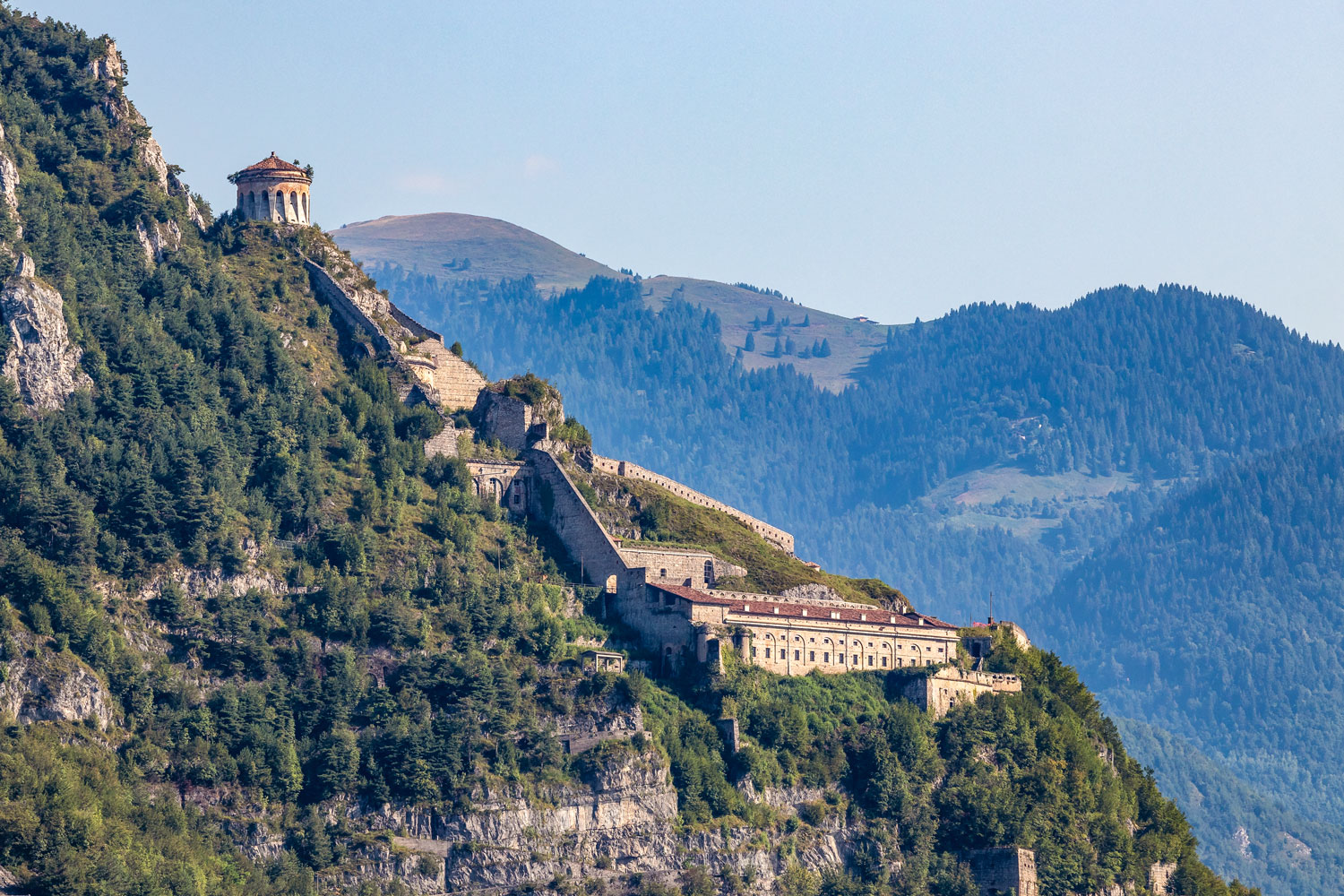
The Rocca d’Anfo fortress is located on the western shore of Lake Idro in northern Italy and was originally built in the 15th century under the rule of the Republic of Venice. Its strategic location allowed it to control important transport routes between Lombardy and Trentino. Over the centuries, the complex was repeatedly expanded and adapted, particularly during the Napoleonic era and under Austrian administration.
The Rocca d’Anfo is characterised by a variety of structures, including bastions, casemates and underground passages, arranged at different levels. The steep stairs and paths connecting the individual defensive structures are particularly noteworthy. Today, the fortress offers exciting guided tours and cultural events and is a popular destination for history buffs and hikers.
Location and topography
The Rocca d’Anfo fortress is perched on a steep ridge with a direct view of Lake Idro. Its exposed location not only allows for extensive surveillance of the surrounding area, but also makes access difficult for potential attackers. The natural environment, with its rugged rocks and steep slopes, was cleverly integrated into the defence strategy, providing the fortress with optimal protection. Today, the site also offers numerous vantage points from which visitors can enjoy the impressive landscape of northern Italy.
Construction history
The construction history of Rocca d’Anfo is characterised by continuous extensions and adaptations to changing military requirements. The fortress was originally built in the 15th century under the rule of the Republic of Venice as a simple fortification to control the strategically important connection between Lombardy and Trentino. During the Napoleonic era, especially at the beginning of the 19th century, extensive expansion work was carried out: Napoleon had the complex significantly enlarged and equipped with modern defensive elements to adapt it to the requirements of warfare at that time. Covering an area of around 50 hectares, it includes batteries, barracks, towers, a network of underground tunnels and passageways, and a belvedere as a lookout point. The fortress was further reinforced and expanded under the subsequent Austrian administration.
Overall concept and structure
The fortress is structured according to a clear overall concept that adapts harmoniously to the terrain. The various defensive structures are arranged on several levels and connected by a sophisticated system of paths and stairs. This ensured both efficient defence and flexible troop transport within the complex. The central bastion forms the heart of the fortress and is surrounded by further casemates and supply buildings, which in turn are connected by underground passages. This structure made it possible to defend the fortress independently over long periods of time and to react flexibly to different threat situations.
Function and use
The function of the Rocca d’Anfo changed several times over the centuries. Originally, it served to monitor and secure the border region, in particular to control trade and military routes. During various conflicts, the fortress was used as an important base for garrisons and provided protection for soldiers, equipment and supplies. In times of peace, parts of the complex were occasionally used for storage or as administrative buildings. Decommissioned during the First World War and left to fall into disrepair for decades, work to protect and reconstruct the unique fortifications began in around 2012. Today, some areas can already be visited again on guided tours, always combined with magnificent views of Lake Idro and the surrounding area. The Rocca d’Anfo Museum, which is part of it, offers visitors a unique insight into the military past of the region as well as immersive experiences. Discover with FORTE CULTURA the unique fortress jewel above Lake Idro.
Architectural features
A striking architectural feature of the Rocca d’Anfo are the casemates cleverly embedded in the rock, which not only offered optimal protection from bombardment, but also enabled the targeted use of artillery through small embrasures. The massive walls and watchtowers that secure strategically important points of the fortress are also characteristic. Particularly noteworthy is the harmonious combination of military functionality and adaptation to the difficult terrain, which is reflected in the numerous winding corridors, staggered levels and carefully placed bastions.
Although the Rocca d’Anfo was primarily designed as a military defence structure with a clear focus on functionality and protection, there are still a few decorative elements to be found. For example, simple stone ornaments or coats of arms were affixed to some entrance areas and representative parts of the building, indicating the respective builders or the era in which they were created.


Significance today
Today, the Rocca d’Anfo is one of the most important historical sights in the region and is a magnet for history buffs and nature lovers alike. The fortress is open to the public as part of guided tours, during which visitors gain impressive insights into the architecture of past centuries and the complex’s varied uses. In addition, cultural events and exhibitions are regularly held on the grounds, keeping the historical heritage alive and making an important contribution to the development of tourism in the surrounding area.


If you see this after your page is loaded completely, leafletJS files are missing.
Contact

 English
  Polish
Leave a Reply